
bsi. 9001:2015 Certified
Established in 1979
4.7 Star Google Rating
Free Samples Available
Premium UK Supplier
Free Delivery Offer
Established in 1979
4.7 Star Google Rating
Free Samples Available
Premium UK Supplier
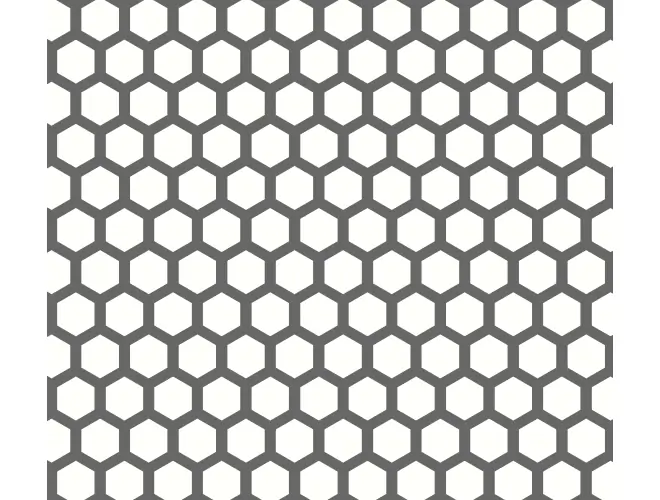
Hexagonal perforated aluminium sheet from Gooding Aluminium, available in five-hole sizes across a staggered pitch layout. The hexagonal perforation pattern produces a honeycomb-effect surface where six-sided apertures repeat across the sheet, maximising the open area while retaining a continuous network of material between holes. Open area percentages in this range run from 41% to 59% — among the highest in the perforated sheet catalogue — making hexagonal perforation the natural choice where ventilation capacity or light transmission needs to be as high as possible without compromising structural integrity.
Hexagonal Perforated sheets are normally dispatched within 2–5 working days on an overnight delivery service.
| Perforation Pattern | Hexagonal (six-sided) holes in staggered pitch |
| Also Known As | Honeycomb style perforated sheet, hex mesh sheet, hexagonal punch pattern |
| Hole Sizes Available | 6.0 x 6.9mm, 9.0 x 10.4mm, 12 x 14mm, 15 x 17mm, 20 x 23mm |
| Open Area Range | 41% to 59% |
| Pitch | Staggered (all sizes) |
| Sheet Size | 2000mm x 1000mm / 2500mm x 1250mm or Custom size |
| Material Thickness | 1.2mm/2.0mm depending on the hole size selected. |
| Material | Aluminium |
| Surface Finish | Mill (untreated) from stock, or Custom surface finishing |
| Dispatch | 2–5 working days |
| Delivery | Overnight nationwide service |
| Custom Options | Bespoke sizing, plain borders, fixing holes, folded edges, powder coat finishes available — contact sales@goodingalum.com |
Posted on Google Dean Cass175 days ago
Trustindex verifies that the original source of the review is Google.
A unique company in my experience, a wealth of products and the ability to customise, with terrific communications and a fast turn around. Highly recommended on all fronts.Posted on GoogleJessica Hazelton182 days agoExcellent customer service & fast delivery. Very happy with their services.Posted on GoogleMarcus Gundry185 days agoVery helpful staff and great servicePosted on GoogleNigel Clarke205 days agoAlways helpful with my query’s and always supportivePosted on GoogleRichard Brooks224 days agoExcellent customer service, fast delivery and unique products. Been using Gooding for many years and never had an issue.Posted on GoogleAndrew Fletcher275 days agoGooding Aluminium were very helpful and competitive. The PPC trims we required were delivered on time and were of good quality. Our client was very happy with the final result, thankyou.Posted on GoogleBD Bespoke Glazing276 days agoFast service with a very good range of stockPosted on GoogleLeisa Turnbull277 days agoAttentive and timely. Good products as described. Highly recommendPosted on GoogleAlex Wainwright280 days agoThey have a specific product and a general level of service that is unrivalled in our industryPosted on GoogleAnastasia Karkazis434 days agoWith their user-friendly and informative website, I easily ordered four samples of perforated aluminium. The quality overall was remarkable, from the material to the customer service via email and phone. I got exactly what I was looking for, thank you Gooding Aluminium!
Sheets are normally dispatched within 2 -5 working days on an overnight delivery service.
Hexagonal perforated aluminium sheet is a flat aluminium panel punched with six-sided (hexagonal) holes arranged in a staggered pitch across the sheet surface. The hexagonal geometry allows the holes to fit close together without too much wasted space between apertures — which is why hexagonal patterns achieve higher open area percentages than round or square holes of a comparable size. The resulting surface has a distinctive honeycomb appearance.
It comes down to geometry. Round holes always leave curved gaps between adjacent apertures, no matter how tightly they are packed. Hexagonal holes straight edges can sit much closer together, reducing the solid material between holes to narrow connecting bridges. This means more of the sheet surface is open for a given hole pitch, which is why hexagonal patterns in this range reach open areas of up to 59%, compared with a typical maximum of around 50% for round-hole patterns.
Five sizes are stocked: 6.0 x 6.9mm (52% open area), 9.0 x 10.4mm (41% open area), 12 x 14mm (56% open area), 15 x 17mm (56% open area), and 20 x 23mm (59% open area). The two dimensions quoted for each hole refer to the width and height of the hexagonal aperture. Open area varies by size because the ratio of hole to bridge width changes across the range.
Yes. All sheets in the hexagonal range can be supplied with a polyester powder coat or anodised finish applied after perforation. These are available within a few days of order. Contact sales@goodingalum.com with your finish and colour requirements.
Yes. Gooding Aluminium offers a cutting service for all perforated sheets. Sheets can be supplied to bespoke dimensions with plain border margins and cut-outs for fixings where required. Depending on the pattern, cut edges may be raw rather than bordered. Contact sales@goodingalum.com for bespoke sizing.
The defining advantage of hexagonal perforation is the open area it achieves relative to the material removed. Where round holes leave curved, unused gaps between adjacent apertures, hexagonal holes with their straight six-sided edges pack tightly together in a honeycomb like arrangement, reducing the solid bridges between holes to the minimum needed for structural continuity. The result is a sheet that transmits significantly more air or light, per square metre than a round-hole or square-hole sheet of equivalent thickness and hole pitch.
Across the Gooding Aluminium hexagonal range, open area percentages run from 41% at the tightest configuration up to 59% at the most open. For comparison, round-hole perforated sheets in the same catalogue typically peak at around 50% open area, and square-hole patterns sit lower still. This makes hexagonal perforation the strongest option in the range where the primary requirement is to maximise throughput — whether that is airflow across a ventilation panel, light transmission through a screening surface, or acoustic transparency in a speaker enclosure or ceiling tile.
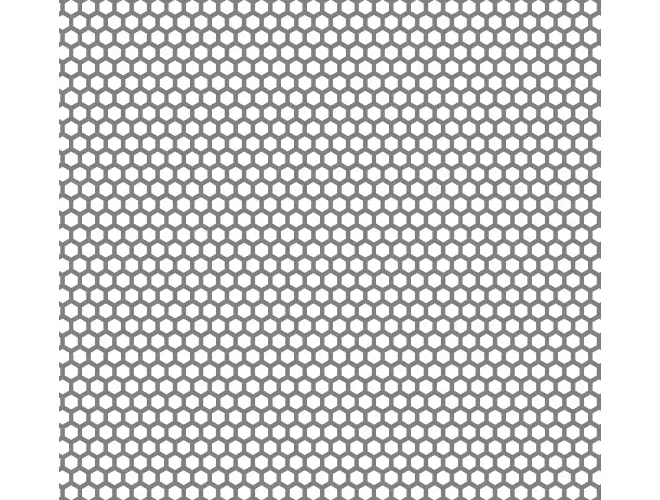
The hexagonal range spans five distinct hole sizes, each producing a different visual scale and open area percentage. At the smaller end, the 6.0 x 6.9mm hole creates a fine-grained honeycomb texture with 52% open area — close enough in scale to read as a uniform surface from a short distance, while still allowing substantial airflow at close range. This suits applications where the sheet will be viewed up close and a refined finish matters: speaker grille panels, equipment enclosures, or small-format vent covers.
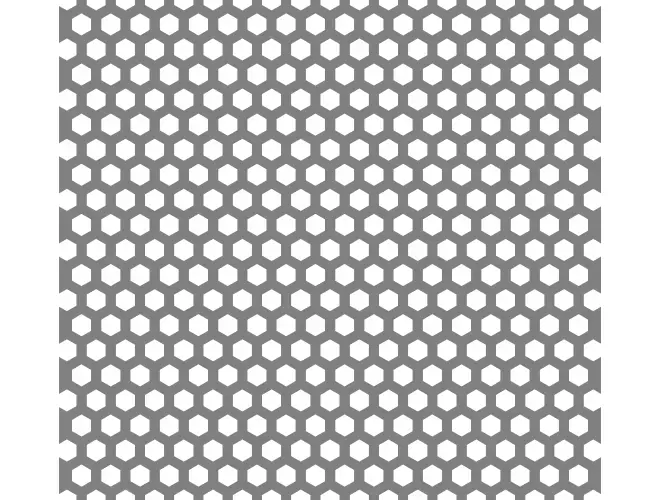
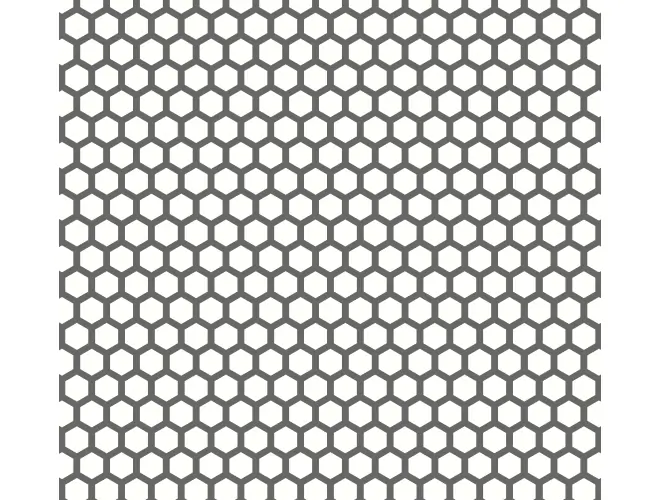
Moving through the mid-range, the 9.0 x 10.4mm size offers the tightest open area in the range at 41%, making it the most visually opaque hexagonal option. The 12 x 14mm and 15 x 17mm sizes both deliver 56% open area but at different physical scales — the smaller of the two producing a more detailed pattern and the larger reading as a bolder, more prominent honeycomb.
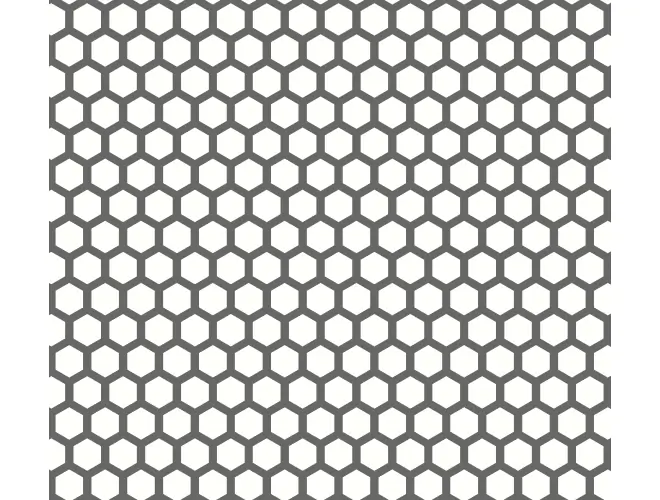
At the largest end, the 20 x 23mm hole achieves 59% open area — the highest in the entire hexagonal range. At this scale, the individual hexagons are clearly visible and the sheet reads as an open lattice rather than a solid surface. This is the strongest choice for large-format ventilation panels, external screening, or any application where maximum airflow and a bold graphic presence are both required.
One of the practical benefits of hexagonal perforation is that the honeycomb bridge network distributes stress more evenly than circular or slotted hole patterns. In a round-hole layout, the solid material forms irregular, curved-edged ligaments between holes. In a hexagonal layout, the bridges between apertures are straighter and more uniform in width, creating a mesh-like structure that resists bending and flexing more predictably across the sheet.
This matters in practice because high open area percentages inevitably reduce the cross-section of solid material carrying loads. A sheet at 59% open area has removed more than half of its parent material, so the geometry of what remains becomes critical. The consistent bridge widths in a hexagonal pattern help the sheet maintain flatness and rigidity over larger unsupported spans, reducing the likelihood of oil-canning, waviness, or localised distortion that can affect sheets with less uniform perforation layouts.
All stock size sheets in this range are manufactured either on 1.2 or 2.0mm thick aluminium in a standard 2000mm x 1000mm or 2500mm x 1250mm format. Where a project requires bespoke sheet sizes, or a specific alloy grade, Gooding Aluminium can do this — contact sales@goodingalum.com.
Standard orders are dispatched within 2–5 working days and delivered via an overnight nationwide service. For projects requiring sheets cut to non-standard dimensions, supplied with plain border margins, or finished with a polyester powder coat or anodised surface, Gooding Aluminium’s processing and finishing services can accommodate these requirements within a short lead time.
Free material samples are available for all sheets in the hexagonal range. Samples are posted first class and typically arrive within a couple of days, giving specifiers and purchasing teams the opportunity to assess the hole size, open area, and surface finish before placing a full order. The honeycomb pattern is one where the physical sample makes a real difference — the interplay between hole scale, light, and viewing distance is difficult to judge from a screen image alone.